
Why Markdown Files Matter for AI Crawlers — and How IndexRender Reduces Cost While Expanding SEO Reach
In the age of AI-powered discovery, content is no longer consumed only by humans and search engines — it is parsed, summarized, and reasoned over by machine agents. And for that, structure matters.
The Shift from Search Engines to AI Discovery Systems
Traditional SEO was built around search engines indexing HTML pages and ranking them in result pages. But the next generation of discovery systems — AI crawlers, large language models, retrieval agents, and autonomous assistants — process information differently.
These systems are not always rendering complex frontends. They prefer fast, structured, low-friction content sources that can be parsed with minimal computational effort. That is why Markdown (MD) files are becoming increasingly valuable.
Markdown is lightweight, semantic, and machine-friendly. Unlike visually layered HTML documents filled with scripts, stylesheets, and hydration logic, a Markdown file provides the raw informational structure directly.
For AI crawlers, Markdown is not just a file format — it is a high-signal, low-noise content source.
Why Markdown Files Are Essential for AI Crawlers
1. Cleaner Parsing with Less Noise
AI systems extract meaning, not design. HTML pages often contain navigation menus, hidden elements, scripts, and styling instructions that dilute the informational payload.
Markdown strips away presentation layers and exposes only the content hierarchy: headings, lists, paragraphs, links, and code blocks. This dramatically improves parsing efficiency.
2. Lower Token Waste in AI Pipelines
When AI systems ingest HTML, they must process excess markup and irrelevant UI structure. That increases token usage and computational cost.
Markdown delivers content in a concise textual form, reducing token consumption while preserving semantic relationships. For large-scale crawlers and retrieval systems, this directly translates into operational savings.
3. Better Retrieval-Augmented Generation (RAG) Compatibility
Modern AI systems often split documents into chunks for embedding and retrieval. Markdown’s natural structure makes chunking cleaner and context preservation stronger.
Headings define topical boundaries, bullet points create logical segmentation, and concise syntax improves embedding quality.
4. Faster Indexing for Machine Agents
AI crawlers prioritize speed. A lightweight Markdown endpoint can be processed significantly faster than a JavaScript-heavy webpage. This enables broader crawl coverage with fewer infrastructure resources.
The Hidden Cost Problem of AI Accessibility
As businesses race to become visible in AI ecosystems, many attempt to expose their content through dynamic rendering or repeated API calls. This creates a serious scalability issue.
Every AI crawler request can trigger expensive backend execution, full-page rendering, database queries, and API orchestration. Multiply that across thousands of crawl events, and operational costs rise sharply.
Without optimization, AI accessibility becomes an infrastructure burden.
How IndexRender Solves the Problem
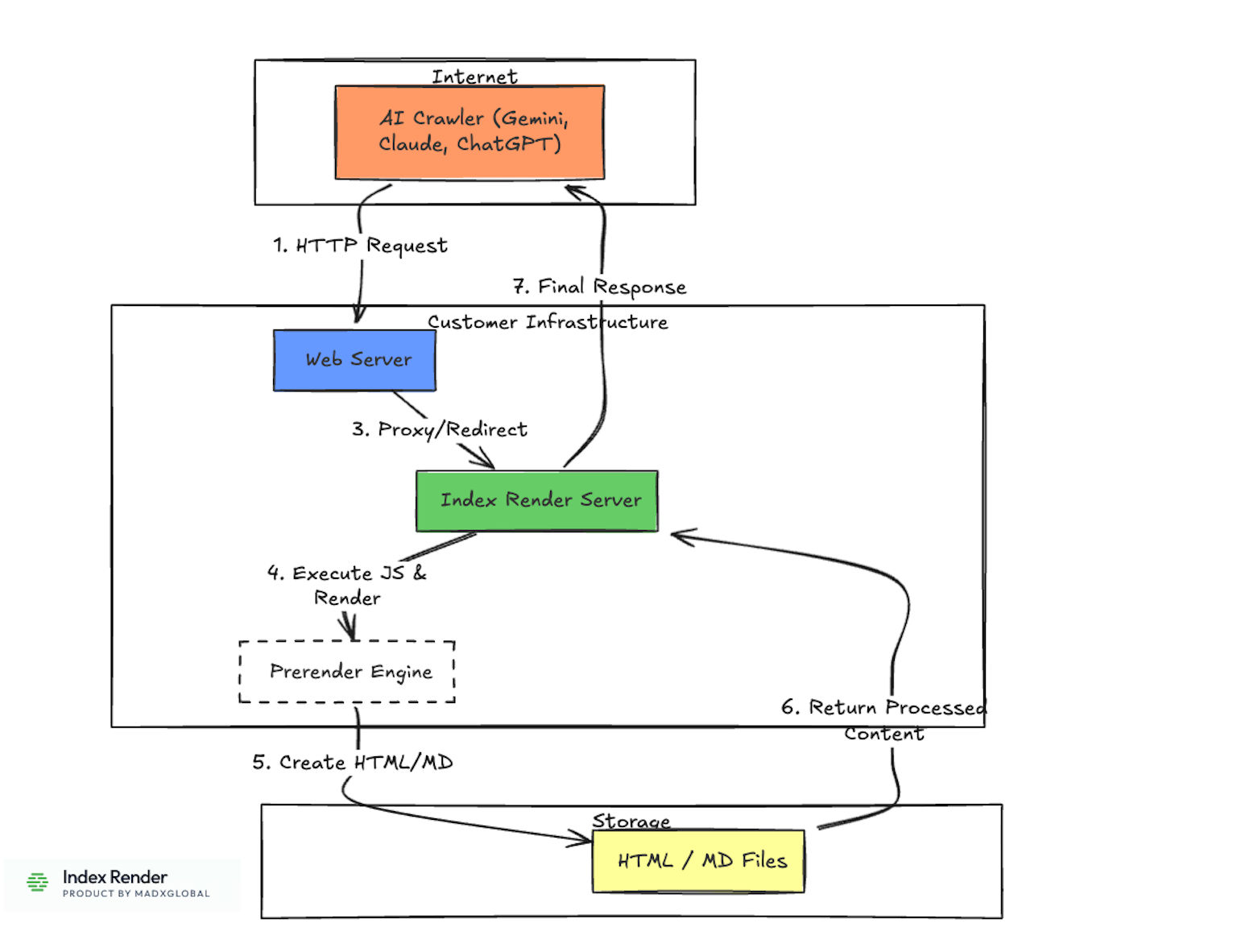
IndexRender provides an intelligent rendering and delivery layer that makes websites AI-ready without increasing backend strain.
Instead of forcing every crawler to execute your application stack, IndexRender generates optimized outputs — including fully rendered HTML and machine-friendly Markdown representations — served directly at the edge.
What This Means in Practice
- AI crawlers receive lightweight, structured content instantly.
- Backend servers avoid repeated expensive rendering operations.
- Content can be delivered as HTML for search engines and Markdown for AI agents.
- Cache layers reduce duplicate processing.
- Infrastructure scales efficiently under crawler load.
How IndexRender Saves Cost
1. Edge-Level Caching
Once a page is rendered, it can be cached and reused across multiple crawler visits. This eliminates repeated rendering cycles and lowers compute expenses.
2. Reduced Server Load
By offloading rendering responsibilities, origin servers handle fewer heavy requests. This decreases CPU usage, memory pressure, and bandwidth costs.
3. Optimized Delivery Formats
Delivering Markdown for AI agents instead of raw application output reduces payload size and processing overhead.
4. Fewer API Calls
Structured pre-rendered snapshots avoid unnecessary backend fetches, lowering database and third-party service costs.
How IndexRender Expands SEO Performance
SEO is no longer limited to traditional search engines. Visibility now spans AI assistants, recommendation systems, knowledge retrieval tools, and semantic search platforms.
By making content available in both crawler-friendly HTML and AI-friendly Markdown, IndexRender ensures broader discoverability across ecosystems.
SEO Advantages Include
- Improved indexing reliability for search engines.
- Greater inclusion in AI-generated answers.
- Higher crawl efficiency across platforms.
- Stronger content reuse in retrieval systems.
- Expanded organic visibility beyond SERPs.
Future-Proofing Content Infrastructure
The web is moving toward machine-mediated discovery. Businesses that prepare structured, accessible, low-friction content will outperform those relying solely on traditional webpages.
Markdown is a strategic layer in that transition. And IndexRender operationalizes it at scale — without forcing teams to rebuild their applications.
The future of visibility belongs to content that machines can read effortlessly.
Final Takeaway
Markdown files are essential because they give AI crawlers a clean, efficient, and structured version of your knowledge. They reduce parsing complexity, improve retrieval quality, and lower operational cost.
IndexRender amplifies that advantage by generating and delivering optimized formats through a scalable rendering layer — helping businesses save money while increasing both SEO performance and AI-era discoverability.
In a world where algorithms read before humans do, structured delivery is no longer optional — it is infrastructure.