
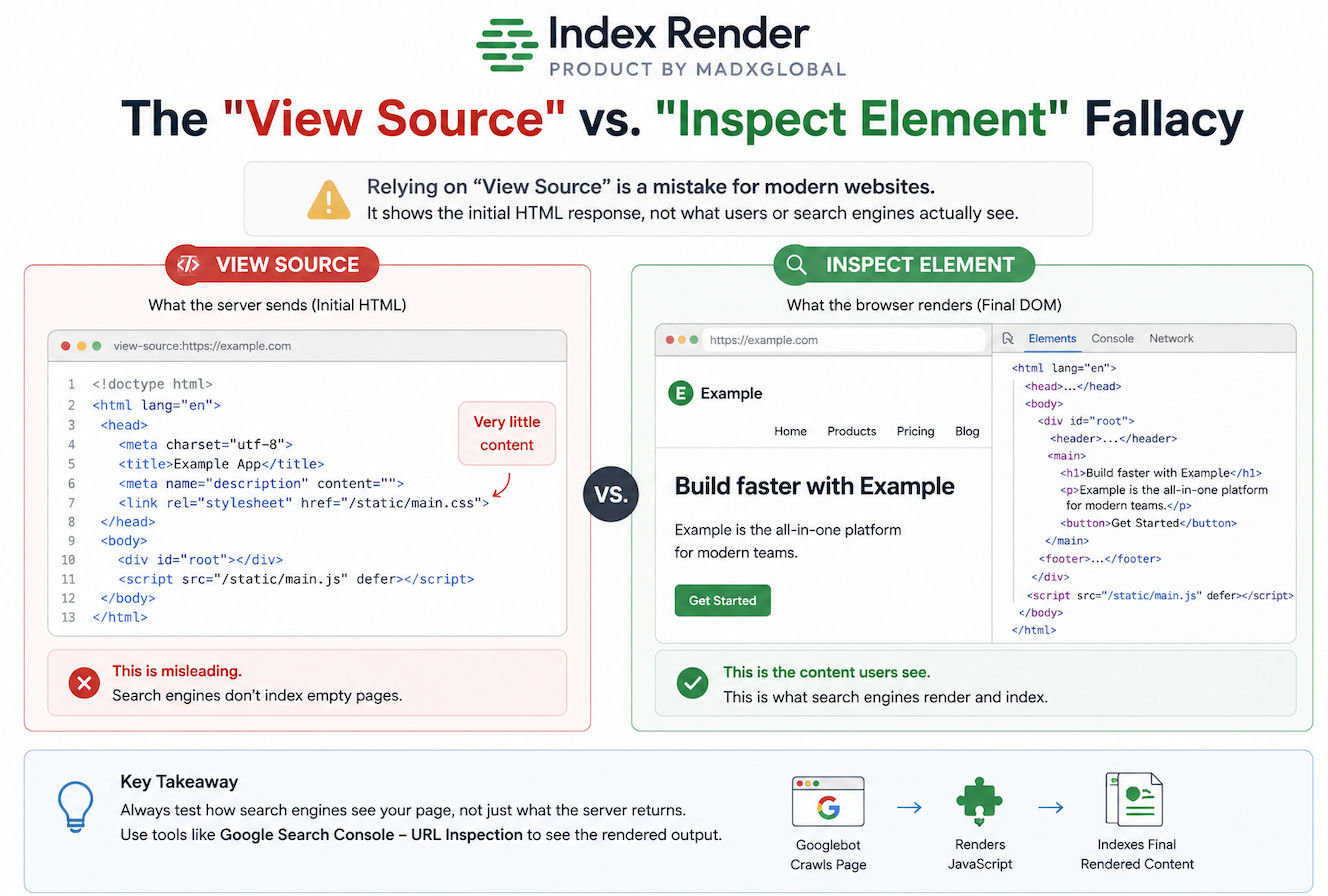
The “View Source” vs. “Inspect Element” Fallacy
Why traditional SEO debugging often misses the real issue — and how modern rendering infrastructure like IndexRender ensures search engines see what actually matters.
The "View Source" vs. "Inspect Element" Fallacy
One of the most common mistakes in technical SEO is relying on “View Source” as proof that a page is indexable. For years, this was enough — because websites were mostly server-rendered. The HTML delivered from the server was the same HTML users and search engines consumed.
But modern web applications changed that model entirely. Today, many sites use Client-Side Rendering (CSR), where the initial HTML response contains little more than a root container and JavaScript bundles. The actual content is injected later in the browser.
This creates a dangerous illusion: developers check Inspect Element, see the final content in the DOM, and assume search engines see the same thing. In reality, they are looking at a browser-processed version — not necessarily what crawlers receive or execute.
“Inspect Element shows what the browser built. View Source shows what the server delivered. Google ranks based on what it can successfully render — not what developers assume exists.”
The real SEO battleground is the Rendered DOM. If critical content only appears after delayed JavaScript execution, failed API calls, hydration mismatches, or blocked scripts, then from a search engine’s perspective, that content may effectively not exist.
Why This Matters for Search Visibility
Search engines do not evaluate your website the same way a user’s browser does. Crawlers operate under execution limits, deferred rendering queues, and resource constraints. If your page depends heavily on JavaScript to populate content, indexing becomes a second-stage process — and not all pages make it through cleanly.
This means:
- Important text may never be indexed.
- Metadata can be incomplete at crawl time.
- Internal links generated by JavaScript may be ignored.
- Structured data may fail if scripts do not execute properly.
- Search rankings can drop despite a visually complete website.
In competitive search environments, even small rendering inconsistencies can mean the difference between visibility and invisibility.
Advanced Audit Workflow
To diagnose rendering-related SEO issues, technical teams need to move beyond superficial checks and inspect what search engines actually process.
1. URL Inspection Tool
Tools like Google Search Console’s URL Inspection reveal how Googlebot rendered your page. The key is not the screenshot — the real value lies in reviewing the extracted HTML and indexed content.
If important sections are missing in the rendered HTML, your content pipeline has a rendering dependency problem.
2. Log File Analysis
Server logs tell the truth about crawler behavior. By analyzing requests from Googlebot and other search agents, you can verify whether bots reach API endpoints, load supporting assets, or abandon execution early.
If bots never request the endpoints that populate your content, your SEO visibility is built on unstable assumptions.
3. Text-Only Cache Testing
A stripped-down text-only cache reveals what remains after rendering layers are removed. This helps detect hidden dependencies on JavaScript execution.
If critical messaging disappears in text-only mode, then your architecture is not delivering durable crawlable content.
Infrastructure Fix: Rendering at the Edge
Once rendering issues are identified, patching individual pages rarely solves the root problem. The real solution lies in infrastructure.
The most reliable modern approach is Hybrid Rendering — serving dynamic experiences to users while ensuring search engines always receive fully rendered HTML.
This is where pre-rendering layers become critical. Instead of forcing crawlers to execute complex JavaScript pipelines, rendered snapshots are generated and delivered instantly.
How IndexRender Solves the Problem
IndexRender acts as an intelligent rendering layer between your application and search engine crawlers. It detects bot traffic, generates a fully rendered HTML snapshot of your page, and serves that version instantly — without requiring changes to your frontend framework.
This means search engines always receive complete, crawlable, index-ready content, regardless of whether your application uses React, Vue, Angular, Next.js, or a custom CSR setup.
What IndexRender Delivers
- Fully rendered HTML for bots in real time.
- Preserved JavaScript experience for human users.
- Accurate metadata and structured data delivery.
- Improved crawl efficiency and indexing reliability.
- Zero framework lock-in.
Instead of relying on search engines to execute your application correctly, IndexRender guarantees that your content exists at the moment of crawl.
“Search engines should discover your content — not struggle to render it.”
The Architectural Shift SEO Teams Need
Modern SEO is no longer just about keywords and backlinks. It is about delivery architecture.
If your content pipeline depends entirely on browser execution, you are outsourcing discoverability to rendering luck. That is not scalable.
By introducing a rendering layer like IndexRender, organizations move from reactive SEO fixes to proactive search infrastructure.
The result is a website that remains dynamic for users, while becoming deterministic and reliable for search engines.