
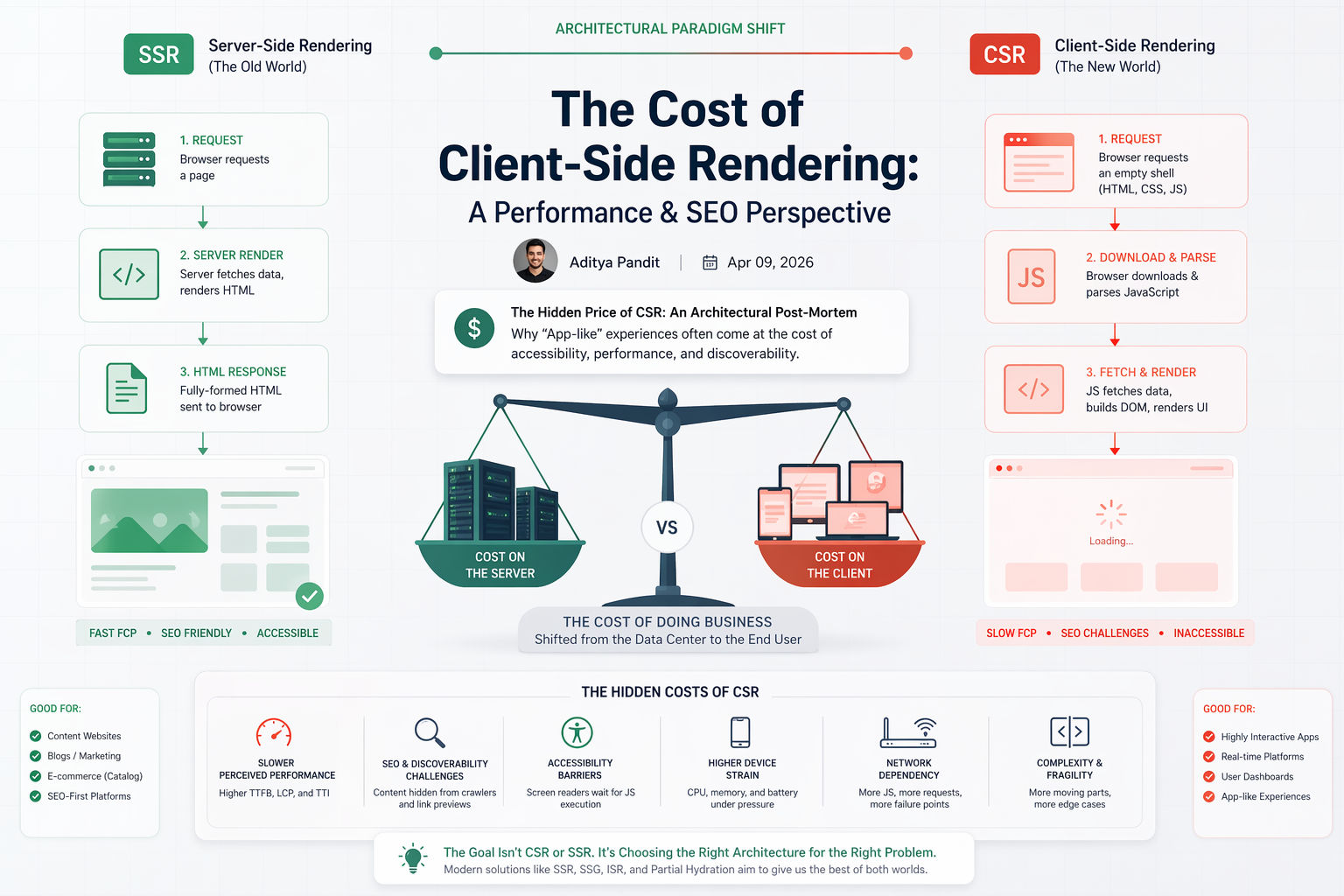
The Hidden Price of CSR: An Architectural Post-Mortem
Why "App-like" experiences often come at the cost of accessibility, performance, and discoverability.
The Hidden Price of CSR: Shifting the Architectural Burden
In the early days of the web, the server was the brain. It handled data fetching, template composition, and logic execution, sending a fully-formed document to the "thin client" (the browser). Client-Side Rendering (CSR) inverted this 30-year-old paradigm. By turning the browser into a heavy-duty application engine, we enabled the fluid, flicker-free transitions of Single Page Applications (SPAs). However, this architectural shift moved the "cost of doing business" from high-performance data centers to the diverse, unpredictable hardware of the end user.
The Hardware Disparity Gap
As developers, we often build on high-end MacBooks or workstations with 32GB of RAM and ultra-fast fiber connections. This creates a "developer bubble." In reality, a significant portion of the global web traffic comes from mid-range mobile devices (like the Moto G series) or older iPhones.
When we ship a large JavaScript bundle, we aren't just asking the browser to download a file; we are asking the CPU to engage in an intensive multi-step process:
- Decompression: Turning the gzipped/brotli transfer into raw text.
- Parsing: Converting the text into an Abstract Syntax Tree (AST).
- Compilation: Just-In-Time (JIT) compilation into machine code.
- Execution: Running the logic that eventually builds the DOM.
On a high-end desktop, this might take 200ms. On a mid-range mobile device, this cycle can lock the Main Thread for 5–10 seconds. During this First Meaningful Paint (FMP) delay, the user is looking at a white screen or a generic skeleton loader. For every second of delay, bounce rates increase exponentially.
Performance Bottlenecks & The Critical Path
The Critical Rendering Path (CRP) is the sequence of steps the browser takes to convert code into pixels. In traditional HTML-first sites, the CRP is streamlined. In CSR, the CRP is effectively "hijacked" by a massive JavaScript dependency.
The Serialized Dependency Chain (The Waterfall of Death)
CSR introduces a linear, serialized chain of events where each step must wait for the previous one to complete. This creates a "waterfall" in your network tab that looks like this:
- The Empty Shell: The browser fetches a minimal HTML file (usually just
<div id="root"></div>). The browser "paints" this empty div immediately, but it is invisible to the user. - The JS Discovery: The browser scans the HTML, finds the
<script>tag, and starts the download. - The Large Bundle Fetch: A heavy JS bundle (often 500KB+ gzipped) travels over the network. If the connection is volatile, this is a major point of failure.
- The Boot-up: The CPU executes the JS. Only now does the application "know" what page the user is trying to see.
- The Secondary API Calls: The JS realizes it needs data (e.g., a product list). It fires off
fetch()requests to an API. - The UI Population: Once the API responds, the JS updates the virtual DOM, reconciles it with the real DOM, and finally renders the content.
Impact on Core Web Vitals
This chain wreaks havoc on Largest Contentful Paint (LCP). Since the LCP element (the main image or headline) doesn't even exist in the DOM until Step 6, the LCP score is often double or triple the recommended 2.5-second threshold. Furthermore, the intensive execution in Step 4 spikes **Total Blocking Time (TBT)**, making the page feel sluggish and unresponsive to touch.
Search Engine Fatigue: The Rendering Queue
There is a persistent myth in the SEO community: "Google handles JavaScript perfectly now, so SSR doesn't matter." This is a dangerous oversimplification. While Googlebot's "Evergreen Chromium" renderer is technically capable of executing JS, it is constrained by Crawl Budget and Computing Power.
The Two-Pass Indexing Reality
Google uses a tiered system for indexing JS-heavy sites:
- Pass 1 (Instant): The crawler fetches the raw HTML. It extracts links and meta-tags. In a CSR app, it finds an empty shell. Google indexes your site as a "blank page" during this phase.
- Pass 2 (The Render Queue): The page is added to a queue for the Web Rendering Service (WRS). Because rendering JS is CPU-expensive for Google, this pass is deferred. It can take hours, days, or even weeks depending on the authority and size of your site.
The Timeout Trap
The WRS does not wait forever. If your JS bundle takes too long to execute, or if your API calls take longer than 5 seconds to return data, the WRS may simply give up and move on. This results in Partial Indexing, where Google only sees your header/footer but none of your actual content. For an e-commerce site, this means your products effectively do not exist in the search index.
The Unseen Memory Cost
Beyond load times, CSR forces the browser to manage a complex State Machine. In a multi-page application (MPA), the browser clears its memory every time you navigate to a new page. In a CSR-powered SPA, the memory persists.
If your application has "leaky" event listeners or uncleared intervals, the memory usage will climb steadily as the user navigates. On a mobile device with limited RAM, the browser will eventually crash or become so slow that it triggers "Jank" (dropped frames). This degrades the very "smoothness" that SPAs were supposed to provide.
How IndexRender Solves the CSR Problem
Rebuilding a modern SPA into SSR or SSG is often expensive and time-consuming. IndexRender solves this challenge without forcing architectural rewrites.
It detects search engine crawlers and serves them fully rendered, SEO-ready HTML snapshots instead of JavaScript-dependent shells. This ensures bots instantly receive complete content, metadata, structured data, and crawlable links during their first visit.
By removing the dependency on JavaScript execution for indexing, IndexRender eliminates rendering queue delays and reduces the risk of partial indexing. This dramatically improves discoverability for blogs, SaaS platforms, marketplaces, and e-commerce sites built with CSR frameworks.
For human users, the original CSR experience remains unchanged—interactive, app-like, and fast. For bots, the experience becomes equivalent to server-side rendering. This creates a hybrid model where businesses gain SEO and performance benefits without sacrificing developer velocity or frontend flexibility.
Conclusion: Moving Toward the Middle
The "Hidden Price" of CSR is a tax paid by the user in the form of battery life, data costs, and frustration. However, we don't have to return to the clunky web of 1995. The industry is moving toward Hybrid Architecture:
- Server-Side Rendering (SSR): For the initial load to ensure SEO and fast FMP.
- Static Site Generation (SSG): For content that doesn't change often.
- Hydration/Islands: To selectively add interactivity back to the static page.
Final Verdict: If your content is the product (Blogs, E-commerce, News), CSR is a liability. If the interaction is the product (Dashboards, Graphic Editors, Spreadsheets), CSR is a necessity. Choose your architecture based on your user's goals, not your developer preferences.