
The State of Modern Enterprise Rendering
For large-scale applications built on React, Vue, Angular, or Next.js, relying entirely on Client-Side Rendering (CSR) is an SEO suicide mission. While Google’s Web Rendering Service (WRS) based on Chromium can execute and crawl JavaScript, it does so in waves. This is known in the SEO industry as the "Second Wave of Indexing." When Googlebot discovers a JS-heavy URL, it initially downloads the bare HTML (which is usually just a <div id="root"></div>). The URL is then placed into a rendering queue. Depending on your site's authority and Google's current computational load, that page might sit in the queue for hours, days, or even weeks before it is actually rendered and indexed.
For an enterprise—such as a massive e-commerce store with fluctuating inventory, a real estate aggregator with daily listing updates, or a news publisher—this "Rendering Gap" costs millions in lost organic traffic. If a product goes on sale for 48 hours, but Google takes 72 hours to render the price change, the SEO value is completely lost.
Traditional solutions like self-hosted Puppeteer clusters or legacy SaaS providers completely fracture when they hit the 5 Million (5,000,000) URL threshold. At this massive scale, memory leaks, zombie browser processes, and astronomical compute costs become a daily operational nightmare. IndexRender.io provides a zero-config, ERP-level bridge that scales horizontally without requiring an entire DevOps team to maintain it.
Technical Benchmark Comparison
| Performance Metric | IndexRender.io | Puppeteer (Self-Hosted) | Prerender.io | Playwright Cluster |
|---|---|---|---|---|
| Render Latency (Speed) | Ultra-fast (1–2s) | Variable (3–6s) | Stable (2–4s) | Medium (2–5s) |
| 5 Million+ Scalability | Native Auto-Scale | Requires complex K8s | Cost Prohibitive | High DevOps Overhead |
| Avg Crawl Throughput | 1,000+ URLs/min | 100–300 URLs/min | 200–500 URLs/min | 300–700 URLs/min |
| ERP Level Readiness | Built-in API / Webhooks | Basic Scripting Only | Limited Meta-Tags | Custom Wrapper Req. |
| Maintenance Effort | 2–4 Hours/month | 40+ Hours/month | 2–5 Hours/month | 20+ Hours/month |
| Infrastructure Cost | Optimized Utility Model | Extreme RAM Overhead | Premium Enterprise Tier | High CPU Compute Cost |
| SLA & Uptime Guarantee | 99.9%+ SLA (Enterprise Grade) | No SLA | Depends on Plan | Self Managed |
| Budget Prediction / Cost Control | AI-Based Usage Forecasting | Manual Estimation | Limited Insights | No Native Support |
| AI Setup Complexity | Plug & Play (Zero Setup) | High (Custom Pipelines) | Low | Very High |
| Built-in SEO Audit | Yes (Automated Insights) | No | Partial | No |
| AI Search (AEO Ready) | Optimized for AI Crawlers | No | Limited | Custom Only |
| Google Ads Safe Rendering | Yes (Bot-safe Rendering) | Risky | Moderate | Depends on Setup |
| Failure Recovery / Retry Logic | Automatic Retry + Smart Queue | Manual Handling | Basic Retry | Custom Logic |
| Queue & Load Management | Distributed Smart Queue | Not Available | Limited | Custom Implementation |
| Cold Start Impact | Near Zero | High | Medium | Medium |
Why Enterprise Architecture Demands IndexRender
1. The "5 Million" Scalability Paradox & Memory Math
When an application reaches 5,000,000 pages, the traditional "browser-per-page" rendering model collapses under its own weight. Let’s examine the raw mathematics of self-hosting a rendering solution.
A standard headless Chrome instance (via Puppeteer or Playwright) consumes approximately 100MB to 150MB of RAM per open tab to execute React/Vue hydration, process CSSOM, and execute network requests. If Googlebot hits your site during a high-velocity crawl spike, requesting just 100 pages concurrently, your server instantly requires 15GB of dedicated RAM just for the browser processes. To render 5 Lakh pages monthly with a high crawl rate (1,000+ requests per minute), you require massive, load-balanced Kubernetes server clusters.
Furthermore, headless browsers are notorious for "Zombie Processes." If a render times out due to a slow third-party script, the Chrome process often fails to close, permanently locking that chunk of RAM. Within 48 hours, your server runs out of memory and crashes, resulting in 503 Server Errors being served directly to Googlebot—a catastrophic event for SEO rankings.
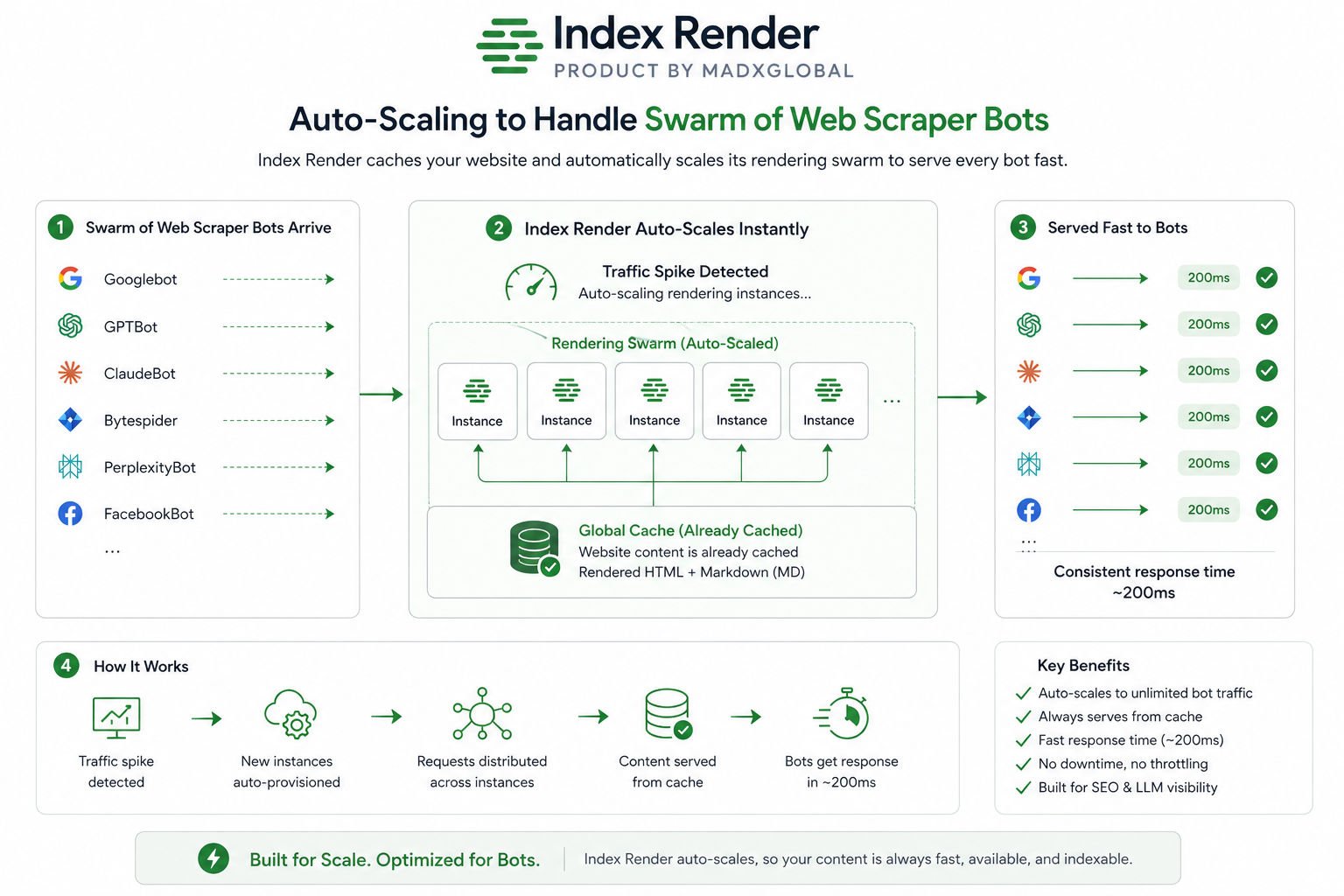
IndexRender.io circumvents this entirely using a proprietary distributed micro-browser pool. We abstract the complexity of Chromium lifecycle management. Our cluster dynamically spins up and destroys rendering nodes in milliseconds, allowing you to hit 1,000+ requests per minute without a single memory leak, timeout, or 5xx error.
2. ERP-Level Reliability and Real-Time State Matching
Enterprise Resource Planning (ERP) integrated websites—like large-scale travel aggregators, programmatic SEO directories, and real-time inventory systems—cannot afford to serve stale content. If your ERP updates a product's stock status to "Out of Stock," serving a cached HTML page that says "In Stock" to Googlebot will result in soft 404s and algorithmic penalties.
IndexRender.io provides direct API integration into your deployment and ERP pipelines. Using intelligent edge-side cache invalidation, ensuring that the bot-facing DOM is always a perfect, microsecond-accurate mirror of your current database state.
IndexRender.io
Architected specifically for massive e-commerce and ERP ecosystems. Features intelligent request queuing, edge-side CDN delivery, and specialized JS execution environments tailored for heavy frameworks (Next.js, Nuxt, Angular). Built explicitly to handle 5 Million+ renders smoothly with zero server-side degradation.
Puppeteer / Playwright
Incredible tools for CI/CD testing, but an absolute nightmare for production SEO at scale. When self-hosting, you are entirely responsible for handling request interceptions, proxy routing, CSS injection, and font rendering delays. At the 5 Lakh threshold, DevOps payroll will vastly exceed the cost of a managed solution.
Prerender.io
A highly reliable, legacy choice for small to mid-sized operations. However, their consumer pricing model is built on rigid "per-render" tiers that become a severe budget blocker at the 5L+ mark. It also lacks the granular, programmatic cache-clearing mechanisms required for high-frequency ERP inventory systems.
Data-Driven Crawl Efficiency: The Economics of Speed
Search engine architecture operates on a concept known as the "Crawl Budget." Googlebot is essentially a massive, distributed chron-job with a time limit. It allocates a specific amount of time (budget) to your domain based on your server's historical response time and your domain's authority.
If your self-hosted rendering solution takes 5 seconds to compile JS and return HTML, Googlebot can only crawl 12 pages per minute per connection. If Googlebot hits its time limit, it leaves, leaving the rest of your new 5 Lakh pages unindexed.
By utilizing highly optimized edge-rendering algorithms, IndexRender.io reduces the average Render Time to under 2 seconds (1-2s TTL). This mathematical reduction in latency effectively doubles or triples your crawl budget overnight. Googlebot processes your site faster, recognizes your server as "healthy and high-capacity," and consequently increases the frequency of its crawls, leading to rapid indexation of new product lines and blog posts.