
The End of Two-Wave Indexing: Why Technical Reliability Defines Modern SEO
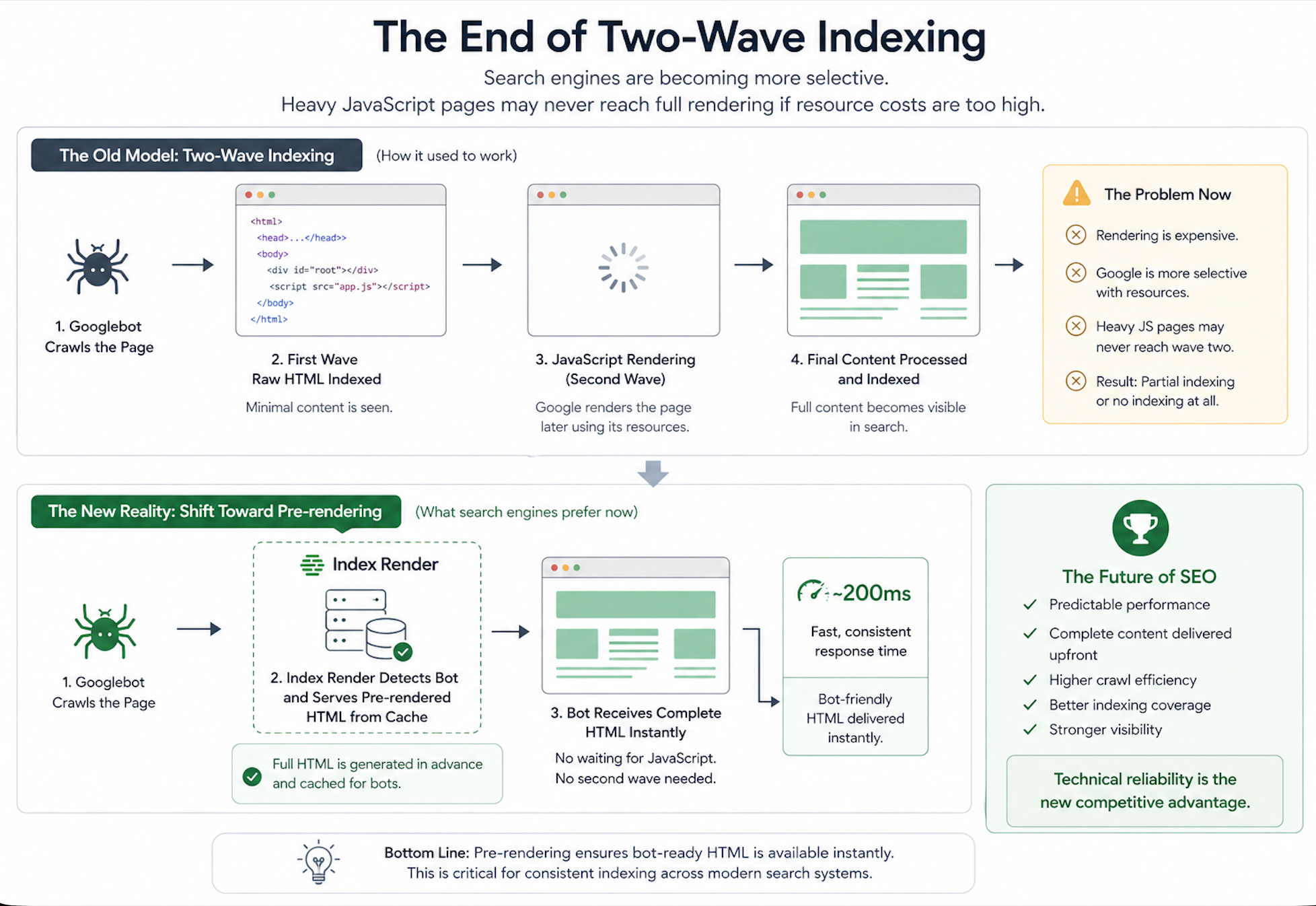
For years, technical SEO teams worked around a search engine model known as two-wave indexing — a system where search engines first crawled raw HTML, then returned later to render JavaScript-heavy pages before final indexing.
That process gave modern web applications a safety net. Even if content was hidden behind client-side rendering, there was still a second opportunity for discovery.
But that era is changing.
Understanding Two-Wave Indexing
Two-wave indexing emerged as a compromise between the traditional web and the rise of JavaScript-driven applications.
In the first wave, search engines downloaded and indexed whatever was immediately available in the initial HTML response. This was fast and resource-efficient.
In the second wave, rendering systems executed JavaScript to generate additional content before updating the search index.
For developers building with frameworks like React, Angular, or Vue, this model created the assumption that even empty HTML shells could still become discoverable once rendering completed.
That assumption is increasingly risky.
Why Search Engines Are Moving Away From Full Two-Wave Rendering
Rendering JavaScript at scale is expensive.
Every JavaScript-heavy page requires additional CPU cycles, memory, network requests, and execution time. For search engines crawling billions of URLs, these costs multiply quickly.
As the web became more dependent on client-side rendering, search engines had to decide where to spend rendering resources.
The result is a more selective approach.
Heavy JavaScript pages may no longer receive guaranteed second-pass rendering if the resource cost is too high or if the system predicts low indexing value.
In practical terms, some pages never make it to full rendering.
They remain partially indexed — or not indexed at all.
The Hidden Risk of JavaScript-Dependent SEO
Many teams still validate indexability using browser tools such as Inspect Element, assuming search engines see the same rendered output.
But search engine crawlers do not experience your site the same way a user does.
They first encounter raw server responses — often minimal HTML containing only a root div and JavaScript bundles.
If rendering is skipped, delayed, or fails, the crawler never sees the final content.
This creates a dangerous gap between what developers believe is indexable and what search engines actually process.
The result can be invisible product pages, missing blog content, incomplete metadata, and wasted crawl budget.
Why Pre-rendering Is Becoming the Preferred Standard
Search engines increasingly favor predictable performance over complex execution paths.
Pre-rendering solves this by generating fully rendered HTML before the crawler arrives.
Instead of relying on JavaScript execution, the search engine receives complete content, structured metadata, canonical tags, and internal links immediately.
This eliminates rendering uncertainty and reduces processing overhead.
From the crawler’s perspective, the page behaves like a traditional server-rendered site — even if the frontend is powered by a modern SPA framework.
That reliability is exactly what modern indexing systems reward.
The Shift Toward Technical Reliability
SEO is no longer just about keywords and backlinks.
It is increasingly defined by technical consistency.
Search systems need fast, complete, and machine-readable content delivered without ambiguity.
Sites that depend on deferred rendering introduce uncertainty — and uncertainty reduces trust.
Technical reliability means ensuring every crawler receives the same critical content every time, regardless of rendering complexity.
It means minimizing dependencies, avoiding fragile execution chains, and prioritizing immediate access.
How Index Render Supports This Future
Platforms like Index Render address this challenge by bridging the gap between modern JavaScript applications and search engine expectations.
Instead of forcing teams to rebuild their architecture, Index Render detects crawlers and serves pre-rendered HTML snapshots instantly.
This ensures bots receive complete, SEO-ready content without waiting for client-side execution.
The result is faster indexing, improved crawl efficiency, and greater confidence that critical pages are fully visible to search systems.
Conclusion
The future of SEO belongs to technically reliable websites.
The old assumption that search engines will always return later to render JavaScript is fading.
Two-wave indexing is no longer a guarantee — it is a conditional resource allocation strategy.
Businesses that depend on JavaScript-heavy experiences must adapt by ensuring bot-ready HTML is available instantly.
Pre-rendering is not just an optimization anymore.
It is becoming a foundational requirement for visibility in modern search ecosystems.
In a world where indexing decisions happen faster and more selectively, technical reliability is the new competitive advantage.